Friday, May 05, 2017

McCullen family still present in County Antrim

I received the message below a few days ago. Please email me at berniecullen@gmail.com and I will forward your message to Charlotte


"I am from County Antrim N Ireland and my maiden name is McCullen.  My fathers family came from Loughmourne in Co Antrim.  In fact Mr Gary McCullen, my dads still living brother, (my dad died in 2003) still lives in the village of Loughmourne.  I know when I was living in N Ireland and growing up noticed there were only a few , maybe 2 other than our family in the telephone book.
I know that my dads cousin emigrated to Canada many years ago, I never met him.  My family were farmers and I believe farmers generations back. 

I now live in East Anglia in U Kingdom.

It is great to read about other McCullens around the world.  I know that Mc rather than Mac in Ireland was protestant surname and names beginning with MacC etc were normally Catholic names.  Interesting.

Any one who thinks they are related to me please contact me

Thanking you.
Charlotte"

Wednesday, April 06, 2016

Update on The only American ever executed in Northern Ireland

Back in 2010 I posted about an Eddie Cullens who was an American citizen, hanged for murder in Northern Ireland in 1932. I quickly was able to learn some additional information but never posted it here:

According to his US Naturalization petition (1927) his birth name was Isaac Joseph Cohen born 4 Feb 1903 in Smyrna. He emigrated to the US from Marseilles on the SS Roma on 20 Jan 1920, arriving in New York on 3 Feb 1920.

I found the ships record at ellisisland.org for free: His name was spelled Jsaac Cohen and he was going to his brother Joshua J Cohen who lived on Broadway, his sister Esther Cohen remained in Constantinople. The date and name of ship was the same as on his Naturalization Petition. The brother's name was (mis)spelled Joshna.

So then the challenge came to find any descendants of his brother Joshua, here is some of what I learned:
According to Joshua Cohen' WWI draft registration card, he worked at the 229 E. Bway address but lived at 104 Essex? He was born June 15, 1890 in Smyrna.
I found Joshua and his family in the 1920 census, but couldn't find them in the 1930, or Joshua alone in 1910, or Eddie in 1920 or 1930. On his Naturalization petition, Joshua gave the name, date, and ship of his arrival:
ship Berlin, 18 Jan (possibly June) 1910 arrived in NY.
At elliisland.org, the ship Berlin is shown as arriving on 18 Jan 1910 (and not at all in June) but I checked the whole list a almost all the passengers were Italian.
I did find him in the ship record, in the index his name is transcribed as Tussesa Cohen, but there is an ink blot over his first name and it could be anything. He was travelling with several other people from Turkey but none named Cohen as far as I can tell. He is on line 28 and listed no contact in Turkey, and in New York, "friend Benjamin Cohen 31[?] St. Mark's Place New York"

I had a look at the 1910 census, and either found Benjamin alone, or didn't find any Cohens at the address, I forget which. But it looks like Eddie/Isaac didn't have any close family in NY other than Joshua.

Also on his Nat Pet. Joshua said he was born 15 May 1890 in Smyrna, Turkey
his wife is Louisa born in Bulgaria on 16 Jun (or Jan). He has one child Margaret Cohen born on July 24, 1912.

On his "Declaration of Intent" from 1910 (on the same .jpg file as the Nat Pet), Joshua gives his occupation as Interpreter.

On his draft card from 1917, Joshua's birthday is again given as 15 May 1890, and is a Clerk at the Hebrew Immigrant Aid Society at 229 East Broadway (the organization still exists but the building is being torn down: http://www.boweryboogie.com/2010/01/demolition-of-225-east-broadway-underway.html)

----The whole point of the above is to show that the attached 1920 census return is really Joshua, even though there are some misspellings, and they list him as being born in Russia. On the 1920 census, Louisa and Margaret are listed, and so is daughter Edith, age 1 year  6? months.

We contacted the HIAS where Joshua worked, they were helpful, but they couldn't find much more than. They found the death certificate for Joshua's wife, but no record of next of kin, etc.
************
So that's where we left it back in 2010. Perhaps there is something more to learn now that the 1940 census is available. It is such an interesting story.

Tuesday, July 15, 2014

Cullens of Carrick, Ballinlough, Co. Roscommon, Ireland

Gerry Cullen of Australia sent me this story:

"My great great grandfather was James (or at least we are led to believe from one old land notice) who was said to be married to Sarah Cullen, of Carrick, Ballinlough, Co. Roscommon, Ireland. Sarah died circa 1861 and the land and house was inherited by my great grandfather Michael Cullen who was married to Mary Scarry, Michael was born circa 1829 and died 1881 aged 52. Therefore his mother Sarah would have been born in the early part (or possibly even before) the 1800's.

"There is no mention of James Cullen in any other documents but an Andrew Cullen appears between the years 1832 and 1840's and I am anxious to find out if this Andrew was in fact an elder brother of Michael or perhaps Sarah's husband (and not James). It is also possible that this Andrew may have died or emigrated during the Great Famine period in Ireland as his name is not mentioned in any documents after. The name Andrew was inherited by my grandfather Dominick Andrew Cullen so there may be a very close family connection.

"Please note that the name Cullen was also spelt Cullinane in this days (with or without the 'e') Records in Ireland are very scarce as most were destroyed by the Civil War in Ireland in the 1920's including the most precious years of the famine era. While I have had no success in finding the answers to the above in various genealogy websites, I though it worth while to include it here as someone living outside Ireland may be a descendant of the abovementioned Andrew Cullen or Cullinane if he did actually sail to America to escape starvation and death."

Tuesday, January 05, 2010

The only American ever executed in Northern Ireland

Eddie Cullens was a Jew born in 1904 in the eastern Mediterranean, different sources say Crete, Cyprus, or Smyrna (Turkey). It is not known what his name at birth was, I think it's unlikely he was born a Cullens. At some point. he moved to the US and was naturalized as an American citizen in 1928 while living in the Bronx, New York. In 1931 he boarded a ship to England and his occupation was listed as "motion-picture projectionist", and he was traveling with a Mr. Zaro Agha, a native of Turkey. According a story from the BBC, Edward Cullens was involved with a circus exhibition of Mr. Agha, the "oldest man in the world" at age 156!

Eddie went to Belfast with another Turkish circus worker, Achmet Musa, who was found shot dead one day. Eddie was convicted of the murder and hanged at Crumlin Road jail, all the while protesting his innocence. As was the custom, he was buried in an unmarked grave on the Crumlin grounds.
http://news.bbc.co.uk/2/hi/uk_news/northern_ireland/8394309.stm
http://en.wikipedia.org/wiki/Crumlin_Road_Jail

Because of new construction at the site, the government is planning to allow the bodies of the executed men to be claimed by relatives, identified by DNA testing if necessary, and reburied in cemeteries. The Jewish community of Belfast is interested in burying Eddie in their cemetery, but so far no relative of Eddie has come forward.

I recently received an email from an interested party who is searching for any relatives or information. Eddie is believed to have had a brother who remained in New York. By searching Ancestry.com databases, I was able to find Eddie's 1928 Naturalization index card, where he was listed as single, living at 1709 E. 174th St., and his ship's arrival record in Southhampton, England in 1931. I have not been able to find him in any census.

If you have any ideas or information, please email me at berniecullen@gmail.com

Friday, December 04, 2009

1911 Irish census: Spelling variations

Cullen is much more common than any of its variant spellings or similar surnames (except for Collins of course). Here are some of the different names/spellings found in the 1911 census of Ireland.

What is interesting about this? Some of the names that appear somewhat common in the U.S are rare or absent (Cullens and Cullins for example, also Cullum/Cullom is rare--maybe it's more of an English name?) Also names mentioned in the surname histories as being variants of Cullen are absent (Culloon, Culhoon).
-------------------------------
If a number is not given, there were less than 10 people with that name in the census, usually only 1 or 2.

CULLEN-7181 names

variant spellings and very rare surnames:
CULAN, CULLAN (66), CULLEEN, CULLEM, CULLENN, CULLAN, CULLENS (8 only), CULLEON, CULLION (96, mostly Donegal, some Tyrone), CULLLEN, CULLIM, CULLIN (82), CULLINS (10 only), CULLOM, CULLUM (15), CULLUMM, CULLON, CULHAM, CULHAN, CULLA (10), CULLAM, CULLANE (15), CULLANNE, CULLE, CULLEA, CULLEAN (10), CULLEANE, CULLEENY, CULLEHY, CULENEY, CULLER, CULLERY (10), CULLEW, CULLING, CULLINY, CULLIS, CULLNEY, CULLOHY, CULLOLY, CULLOO (17), CULLUANE, CULM, CULMEA, CULLINGNE, CULLMAN, CULLNEY, CULLOM, CULLON, CULLUM,

Then there are some names that are clearly different families, not just spelling variations:
CULHANE (611, mostly Limerick)
CULL (232, Down, Leitrim, Antrim and a few other counties)
CULLINEY (44, Mayo and Clare)
CULLINAN (863, Waterford to Roscommon)
CULLINANE (1240,Waterford to Roscommon)

Then there are the variant of McCullen:
McCULLEN (91), MacCULLEN (1), McCULL (17), McCULLION (12), McCULLAN (12), McCULLINS (11), McCULLIAN, McCULLIN, McCULLON, McCULLUM, McCULLAND, McCULLEM, MCULLIN

This list is only for names containing CUL, so names like COLLEN, COLLINS, KILLEN, QUILLEN, and McQUILLAN are not listed

Wednesday, October 28, 2009

Complete 1911 Census of Ireland now available online, for free

One of my contacts just informed me that the complete 1911 Census is now available and easily searchable at: http://www.census.nationalarchives.ie/search/

Be sure to click through to see the original handwritten census returns.

The 1901 census will be made available within a year, hopefully. All earlier censuses for Ireland were destroyed, and later censuses have not yet been released for privacy reasons.

My own great-grandfather had already emigrated to Chicago by 1911, but his sister and other relatives in Tullycorker, Tyrone appear in the census.

In the coming weeks I hope to add some posts about Cullens in the 1911 census, about things like different spellings of Cullen, Protestant Cullens, and Irish speaking Cullens.

Friday, May 22, 2009

Cullens in Chile

Here's a posting from Dr. Juan R. Cullen, MD, about his Cullen family who emigrated from Dublin to Chile, South America around 1908. Other members of the family ended up in Liverpool, England, and Louisiana USA.

I don't want to post Juan's email address here without his permission, but you can leave comments here or email me (berniecullen@gmail.com) and I will forward them. Just be sure to leave an email address so we can contact you!

Juan R. Cullen wrote:

"I need any information about Robert Cullen (gr-grandfather), living second half of the 19th Century in Dublin (7 Greenville Terrace, South Circular Road). Robert was Assistant Curator Pathological Museum TCD (Trinity College Dublin). Married Catherine Delaney, and parents of Robert Cullen Delaney (my grandfather), who was born on February 17th., 1885. Robert Cullen Delaney emigrated to Argentina (first arriving to Sandy Point in Chile, and later settled in Rio Gallegos, Argentina) on board the ship Oriana, leaving Liverpool on December 16th., 1908. My grandfather had at least two brothers: Joe (Joseph), who emigrated to Louisiana, USA, around last years of the 19th. century, or most probably at begining 20th. century. I’ve no other details about his life. The other brother, Patrick, born about 1897, had to leave Ireland due to be pursued by the English army as it was an IRA member. He left Liverpool on 08 July 1920, at the age of 23 years, aboard the ship Orduna, and shelter with my grandfather in Rio Gallegos. Later he went to Louisiana to see the other brother, and finally return to the Republic of Ireland.

My grandfather also had at least one sister who joined a religious order and remained until about twenty years ago in a convent in Liverpool. She is almost certainly already dead.

My grandfather was married in Rio Gallegos with Lavinia Cox, daughter of an administrator of the coal mines in Chile, which had been recruited in Wales.

Robert Cullen Delaney, my grandfather, married and with three children (two men and a girl, all between five and ten years old at that time) had to leave Argentina for health problems, and headed to California to settle there, but the ship that they moved made a landfall in Chile, and they decided to stay in this country.

Any information regarding siblings of my grandfather and my great grandfather and other ancestors would be very grateful."

Great site for Cavan Cullens:

Mark Cullen of Canada has created a great site with the history of his family who went from County Cavan, Ireland to Quebec: http://www.cullenancestry.ca

In Mark's words: "
John Cullen of Killinkere area and Elizabeth Carolan, daughter of Simon Carolan and Catherine Clarke of Doon, emigrated in 1826 to Bytown, Upper Canada and resettled to Templeton Township with their children Mary, Anthony, Michael, Bernard, Elizabeth, Catherine and John. They became important farmers and squared timber operators and leaders in church and community affairs and local politics."

This is of interest beyond Mark's own family--many Irish first emigrated to Canada before moving to the US (and of course some stayed in Canada). And eastern Cavan was home to a large cluster of Cullens, as my maps below show.

Mark has a comment submission form on his website.

Sunday, February 08, 2009

McQuillan connection?


It looks like we have found a DNA connection between 3 McQuillans from Counties Monaghan and Fermanagh, a Cullen from an unknown location in Ireland, and a Collins in the US who believes he can trace back to a Callan family from Meath...and these seem to all be related to the McMahon family who were chiefs in the area...Many different surnames, but first some maps of the McQuillan surname in the mid 1800s and today (click on maps to enlarge, and be sure to compare these with the McCullen and Cullen maps below. If you need the names of the counties, go to http://en.wikipedia.org/wiki/Counties_of_ireland


The maps are very similar (unlike the McCullen surname which essentially disappeared in the last 150 years). There has been a large increase in McQuillans in and around Ballymena in Co. Antrim, and in general I would say that McQuillan is found more in towns and suburbs than Cullen for example, but then Antrim, northern Armagh and Louth are have always been densely populated places. Another change is a decline of the surname in Fermanagh, and a shifting of the main cluster of the surname in Monaghan from the Clones area to an area more to the northeast.

For the Griffith's data, there were many spellings but I think I caught all that contained "Quil", but didn't include on the map surnames like McQuillinan, McQuillcan. The BT phone book for Northern Ireland was easier to search than the Eircom for the Republic, and in the BT book I searched for all variants of Quillan and McQuillan but there were only two listings--one Quillan and one McQuillam. In the Eircom directory, I searched for McQuillan only. (note--I haven't mapped the phone listings for Dublin yet--hope to fix this soon)

Friday, December 12, 2008

McCullen mystery


Apparently the name McCullen was once common throughout Ulster, but today is almost non-existent. Even at the time of Griffith's Valuation in 1860, there were McCullens in Clogher Civil Parish, home to my ancestors, but I found no trace of them in the civil records or census in later years.

Where did the McCullens go? Did they die out, emigrate, or change their name to Cullen or something else? Were there ever Scottish McCullens? The answer seems to be no (see my posts on the Cullen surname in Scotland).

Here is a map of the McCullen surname in Griffith's, and also one from telephone books in 2006. The only place that has stayed a stronghold is in/near Drogheda. If you compare this to the maps of the Cullen surname, it also doesn't seem as if the McCullens have changed their name to Cullen in most places: for example, in Griffith's there were many McCullen families in northeastern Cavan, southeastern Fermanagh, northwestern Monaghan, and today there are neither McCullen nor Cullen families there. Of course there has been a huge depopulation of rural Ireland in the past 150 years.

Some notes about the maps:
--in the Griffith's map, I include several McCullum families as red dots (mostly Antrim, also Armagh, Down, Monaghan, Derry). This may be a completely different family, but may be a mispelling of McCullen
--McCullen had several variant spellings: McCullan, McCullin, McCullian, McCullion. Cullion and Cullian were common alternate spellings of Cullen in the North (including in my family). Maybe this reflects the pronunciation?
--the Mac vs. Mc spelling is not really an issue, I have found no MacCullens (except 1 in the USA), and Griffith's recorded all names as Mc, which is just an abbreviation of Mac
--for the 2006 map, I was able to search for every possible variant of the McCullen name in Northern Ireland, and I found only 4. Three were named McCullen, and one was named McCullins (this one in Newry, on the southern Down/Armagh border). For the Republic of Ireland, I only looked for McCullen.

Finally, there are several other names found mainly in Ulster and Co. Louth that could be confused with Cullen and McCullen: McQuillan, McCallan, Killen and others.

Are there any McCullens out there reading this?

Wednesday, November 19, 2008

Progress at DNA Project--updated Feb 2009


Feb 2009 update--we now have located the Irish homeland of DNA project member C-42: his ancestor Joseph Cullen was born in 1870 in Loughgall in northern County Armagh. This is right in the middle of the large "Lough Neagh" cluster of Cullen, another member is C-37, whose ancestors are from Pomeroy, Co. Tyrone

Both C-42 and C-37 belong to the "Northwest Irish" group called R-M222, which is associated with "Niall of the Nine Hostages". Perhaps these two members represent different families who took the Cullen name independently centuries ago, but there is some DNA evidence that indicates they are descended from a single Cullen ancestor. So for now, I am placing them both in our "Lough Neagh" lineage, but we need to test more Cullens from Armagh and Tyrone to confirm this.
----------------------------------------------------------------

After about 2.5 years organizing the Cullen DNA project, we are starting to make some satisfying connections. This month we saw a match between one of our original members who is an Irish-American Cullen with roots in County Waterford, and an Irish Cullinan from Co. Waterford. This confirms an old family story that the name was changed to Cullen upon arrival in New York.

Our other major Irish lineage so far identified is the Co. Wicklow line, which turns out to be related other Wicklow chieftans, like the Byrnes and Kavanaghs. Most Irish Cullen from other counties have heard of the Wicklow Cullens and wonder if they are connected to them--the answer so far is no!

Here is an updated map showing our 14 members with a known origin in a specific village or parish in Ireland.

Tuesday, July 01, 2008

Distribution of Cullens in Scotland

A very large percentage of people named Cullen all over the world go back to Cullens from Ireland. But we know there are native English and Scottish families as well. The situation is confused because many Irish Cullens emigrated to England and Scotland over the last 200 years, and some Cullen descendants may not know where their family was originally from.

To investigate this, I searched the 1841 and 1881 Scotland censuses trying to identify established Cullen families. I defined these as households where the male head of the family was born in the same county and parish where he resided at the time of the census. I chose the 1881 census because the Great Britain Family Names website provides a map of the surname for that year, click here

Here are some of my findings:

--because the industrial revolution was strong in Scotland, many people had moved away from their birthplaces even in 1841
--In 1841 there were only a few Irish-origin Cullen families, mainly in the Glasgow area, but by 1881 the number of Irish-background Cullens in Scotland was roughly equal to the number of Scottish-background Cullens
--There is only one name occurring in any quantity that is similar to Cullen and which could possibly be confused with Cullen--Collin and Collins. All other variants and spellings (Collen, Cullin, Cullins, McCullen, Collinge, Cullane and many others) were very rare in Scotland in 1881.

--there are only 3 general areas where I found long established Cullen families:
1. The first area is up the Clyde valley from Glasgow (Lanarkshire). By far the largest number was in the area called the Monklands, including the towns of Airdrie and Coatbridge. Although this area was industrialized, Cullens had a variety of occupations including farming, many trades, merchanting, indicating a long presence.
There also were a small number of farming Cullen families in south Lanarkshire, near the towns of Carstairs and Carluke
Glasgow itself had several established Cullen families, although not as many established families as the Monklands.
2. The second area has just a few Cullen families. This is Aberdeenshire in the northeast. There were a couple Cullen farmers in Strathdon which is is in the highlands west of Aberdeen, and also in Keig about halfway to Strathdon. Then there were 5 Cullen families living in the Buchan region a few miles inland from Peterhead, in the towns/parishes of Longside, New Deer, Old Deer.
3. In 1841 there were a very few established Cullen families in the Central Belt in what was then called Stirlingshire and Perthshire, roughly around Falkirk and Sterling (specifically Falkirk, Deanston, Drip Moss and Doune). By 1881 the native Cullen presence was much reduced and less connected to the land.


That's it! In 1881 in all of Scotland I could only identify 75ish families where the Cullen male head of household was still living in the same civil parish where he was born. For comparison, there were 79 heads of household (male and female) named Cullen who were born in Ireland.

Of course there were many more Scottish origin Cullen families in addition to these 75. You can tell by their birthplace that they were born in Scotland, and they often had Scottish given names (Alexander, Adam, Archibald Gavin etc.) But they were not living in their home parish.


Maybe I have omitted some important families? Please reply with any additions or corrections.

Here's a summary of the 75 families in 1881 and their location:

Aberdeenshire (7)--5 in Buchan (Longside, New Deer, Old Deer), 2 in Strathdon

Dumbartonshire (2)--from Cardross--one physician, one farmer

Lanarkshire
(53)--Monklands--Coatbridge and Airdrie(20+), Glasgow(16+), Bothwell(4+), Motherwell(Dalziel) 5+, Carluke (4), Carstairs(2), and possibly some long-term families from Hamilton, Partick, Rutherglen and Stonehouse

Perthshire (3)--Dunblaine, Kilmadock, Kincardine--1 farmer, 1 grocer, 1 laborer

Renfrewshire (4)--Greenock West, Paisley(2), Pollockshows: all tradesmen

Stirlingshire (4)--Labert, Bannockburn(2), Falkirk: 3 laborers or servants, 1 tradesman

Saturday, May 17, 2008

Cullen Vampire DNA

Just for fun, let's imagine that we could test the DNA of the fictional Cullen family of vampires from the Twilight books by Stephenie Meyer http://en.wikipedia.org/wiki/Twilight_(series)


I haven't read the books yet (maybe I'll wait for the movie coming out later this year), but it seems like there is a big family tree of vampires with the last name Cullen. Most of these were adopted: Edward Cullen, Emmett Cullen and Alice Cullen all had different last names originally. So we wouldn't expect them to match any of the members of the Cullen Family DNA Project.

But the patriarch of the family, and the original vampire, Dr. Carlisle Cullen, was born a Cullen in London, England in the 1600s. His father was an Anglican minister. These are some good clues to tracing his possible real-life Cullen relatives. As discussed in the post below, there were three main centers of the Cullen surname in England: in Somerset in the southwest, around Nottingham in the middle of the country, and Kent in the Southeast.

Of course, Kent is close to London, so it's most likely that Carlisle is related to our member C-23 whose ancestor Arthur Cullen was from Deal, Kent:
http://www.worldfamilies.net/surnames/c/cullen/results.html


After living as a vampire in Europe for two centuries, Carlisle Cullen came to the American midwest (Chicago then Wisconsin). Interestingly, there was a real man named Joseph Cullen who came to Kentucky around 1850. He was born in Kent, England, and he was a Protestant minister. Could this be a connection to Carlisle's family?


So to summarize, please get in touch if you are a Cullen man willing to be tested for our DNA project. The Cullen family of vampires may be fictional, but we can see if you have a real genetic connection to our other families in Kent and throughout the world.

Sunday, October 28, 2007

English and Scottish Cullens in 1881

As some of you might know, there were only a few places in England
where the name Cullen was found in the 1800s: the main areas were
central England (Nottinghamshire and surrounding area), southwest
England (Somerset), the cities of London and Liverpool (probably
mainly recent Irish immigrants) and a very high concentration in the
extreme southeast of England--Kent!
You can see the map for England, Scotland and Wales at the surname
profiler (link corrected November 2016)
here (click on the 'Search for a Surname' circle, then type the surname Cullen and select the year 1881):


Has anyone investigated the census in more detail for 1881 to see which Cullen families originated in Ireland versus Scotland or England? This would be especially interesting for the Cullens in Scotland. I'm about to start some research on the censuses available at http://ancestry.co.uk so let me know if you have already done some work on this so I don't repeat it.

Here's a note that Jim Cullen of the best Cullen genealogy website sent me (his website address is http://www.lrbcg.com/jtcullen

Collins.
(3rd S. xi. 84,161,323.)
Your correspondents ALTER and C.T. COLLINS TRELAWNY may find the following of service:-
Mr. M.A. Lower, in his Patronymica Britannica, derives the English names Culling, Collins, &c. - the Scottish Cullen and Cullan - the Irish Cullen - from Cuillean and O'Cuillean, the tribe-name of some Irish clan. He may be possibly right as far as the Irish "Cullen" or "Cullin" is concerned. He is totally wrong about the Scottish Cullen - a name properly spelt Cullayne or Cullane, and borne by a family who held lands of that ilk near the stream of the same name in Banffshire as early as the thirteenth century. Respecting the English "Collins," &c. he has made an equally hasty and erroneous decision. A glance at any Armory or Heraldry will show that all the English families spelling their name indifferently Cullen, Collen, Culling, Cullinge, and Collins - whether of Kent, Essex, Staffordshire, or Devon - are of one stock, bearing the griffin segreant (differenced) on their shield, and probably all having their origin in a parent stem deriving its name from the village of C
ulinge, in the hundred of Riseburge, Suffolk, mentioned in Domesday (292b.) as owned by "Comes Alanus."
In Kent the form of Cullen is most common. Folkestone churchyard is full of tombstones bearing it; and it may be traced at Canterbury, and all along the east coast and Isle of Thanet.
A gentleman who settled at Woodlands, near Ashburton, Devon, is called Cullen in the county histories, and Culling in the Harl. MSS. where his arms are given. His line terminated in an heiress who, four or five generations back, married Fursdon of Fursdon. In Essex, Collen appears most usual, and still exists there in a good family. Collins is a corruption found everywhere. Any good heraldry will give every variation of the name and difference of the coat armour. There is but one exception to the rule that all this family of names derive from one original "Culinge"; and that, although no one now exists of the race who bore it, it may be as well to mention. Richard Cullen, of an ancient family of Breda in the Duchy of Brabant, descended from Arnould von Ceulen, living A.D. 1300, came to England on the persecution of the Protestants by the Duke of Alva. His son or grandson was created a baronet by Charles II. The family, however, became extinct, apparently even in the female
line, in 1730. (Burke, Extinct Baronetcies.)
X.C.

----------------------

[The village of Culinge in Suffolk is now known as Cowlinge.]
[The word Comes appears in documents during the reign of the Conqueror, and later. It appears at least thirty-five times in the Doomsday Book (Index Nominum Personarum, Libri vocati Exon' Domesday, p. 606), beginning with such names as: Comes Alanus, Comes Albericus, and so on. Comes in this case has sometimes been mistaken for a family name. Comes, therefore, in this instance means simply Earl (also a follower, or companion). The pronunciation is Co-mes, in two syllables.]

----------------------

Friday, July 13, 2007

English Cullens in Tasmania

There is a great story here that I'd like to learn more about:
http://www.heavenandhelltogether.com/index.php?q=node/31 (link updated May 2009).

In 1835 Luke Cullen was convicted of stealing by a court in Middlesex, England (near London), and sentenced to 7 years transportation to Van Diemen’s Land, which is now called the island of Tasmania, Australia.

He married Elizabeth Bunker and it looks like they had a large and successful family and many descendants. One of his direct male descendants submitted a DNA sample to the Sorenson Molecular Genealogy Foundation a year or more ago, and now has results available.

I would like to get in contact with anyone of this family or who knows the family.

Friday, March 09, 2007

Trip to Ireland

Thanks to this Cullen genealogy blog, I got in touch with Pearse Cullen of Northern Ireland (See his comment on Cullen's point altar field).

It's hard to believe that he is new to genealogy research because he's so interested and good at it. I found a cheap ticket to Dublin on Washington's Birthday weekend, and drove up to Tyrone to meet Pearse and his family. It had been almost 18 years since I last visited, but the area was beautiful as I remembered. This time Pearse and I had figured out how I was related to everybody--when I met his uncle Vince Cullen back in 1989, we suspected a connection but weren't sure exactly how.

Here's a picture of me and Pearse approaching the field of our ancestor, Thomas Cullen. (Pearse's relatives remember when Thomas' house still standing here, but today only the foundation remains). More pictures are available, just send me an email if you'd like the link.

(temporarily unable to upload pictures to blog--check back later)

Thursday, October 12, 2006

New Cullen Distribution Map

Map Updated June 2008 with new DNA Project Members


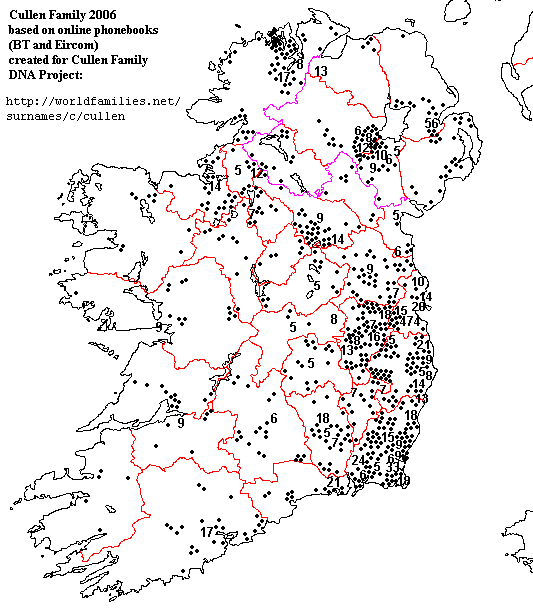
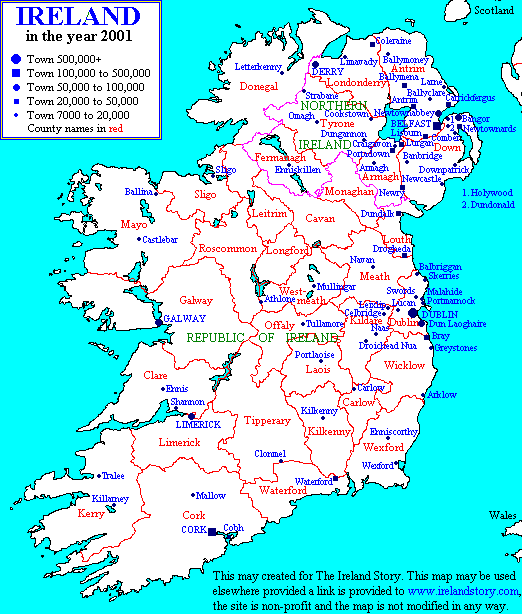
Download this map and you can see it in much better detail (doubleclick to see it fullscreen, or right-click and save the picture). This is based on Griffith's Valuation from the mid 1800s. I placed the dots on the map by hand, but they are mostly accurate. This map will be useful for the Cullen Family DNA Project: http://www.worldfamilies.net/surnames/c/cullen/ The red Xs are where some of our members' families are from, and the red ?s are our members who only know the county their Cullen ancestors are from. (If your eyes are good enough to see some bluish dots, those are families spelled Cullion or Cullian). Obviously, most of the Cullens lived in the southeast of Ireland, in Dublin, Wicklow, Wexford, and that's where we need to get more members. The second map shows the current distribution of Cullens based on online phone books. The lower map is a reference map showing county names and largest towns. It's from http://www.irelandstory.com/ which has lots of interesting maps and history.

Tuesday, August 01, 2006

Cullinane/Cullinane distribution map


Distribution of Cullinans and Cullinanes based on Griffith's Evaluation (1848-1868). Cullinan is the blue dots, and Cullinane is the red.

Compare this map to the map showing the distribution of Cullen, and note how there is little overlap. (except in Tyrone where my Cullens are from, and which is the only place in Ulster where Cullinan was found).

Monday, June 05, 2006

Cullens in Clogher history: Priests: Archdeacon Muireadhach O'Cuillen

from lewis' topographical dictionary of Ireland (1842):
Tyrone--Clogher
scroll down or search for Clogher or O'Cuillen:

Clogher is called by Ptolemy Rhigia or Regia; and according to some authors, St. Patrick founded and presided over a monastery here, which he resigned to St. Kertenn when he went to Armagh, to establish his famous abbey there; but according to others, it was built at the command of St. Patrick in the street before the royal palace of Ergal, by St. Macartin, whoe died in 506, and from its vicinity to this palace both the abbey and the town appear anciently to have been called Uriel or Ergal. In 841, the abbot Moran Mac Inrachty was slain by the Danes. In 1041 the church was rebuilt and dedicated to St. Macartin. In 1126 the Archdeacon Muireadhach O'Cuillen was killed by the people of Fermanagh. Moelisa O'Carrol, Bishop of Clogher, in 1183, on his translation of the archbishoprick of Armagh, presented to this abbey a priest's vestments and a mitre, and promised a pastoral staff; he also consecrated the abbey church. etc etc

Why did the people of Fermanagh kill the archdeacon?