As some of you might know, there were only a few places in England
where the name Cullen was found in the 1800s: the main areas were
central England (Nottinghamshire and surrounding area), southwest
England (Somerset), the cities of London and Liverpool (probably
mainly recent Irish immigrants) and a very high concentration in the
extreme southeast of England--Kent!
You can see the map for England, Scotland and Wales at the surname
profiler (link corrected November 2016)
here (click on the 'Search for a Surname' circle, then type the surname Cullen and select the year 1881):
Has anyone investigated the census in more detail for 1881 to see which Cullen families originated in Ireland versus Scotland or England? This would be especially interesting for the Cullens in Scotland. I'm about to start some research on the censuses available at http://ancestry.co.uk so let me know if you have already done some work on this so I don't repeat it.
Here's a note that Jim Cullen of the best Cullen genealogy website sent me (his website address is http://www.lrbcg.com/jtcullen
Collins.
(3rd S. xi. 84,161,323.)
Your correspondents ALTER and C.T. COLLINS TRELAWNY may find the following of service:-
Mr. M.A. Lower, in his Patronymica Britannica, derives the English names Culling, Collins, &c. - the Scottish Cullen and Cullan - the Irish Cullen - from Cuillean and O'Cuillean, the tribe-name of some Irish clan. He may be possibly right as far as the Irish "Cullen" or "Cullin" is concerned. He is totally wrong about the Scottish Cullen - a name properly spelt Cullayne or Cullane, and borne by a family who held lands of that ilk near the stream of the same name in Banffshire as early as the thirteenth century. Respecting the English "Collins," &c. he has made an equally hasty and erroneous decision. A glance at any Armory or Heraldry will show that all the English families spelling their name indifferently Cullen, Collen, Culling, Cullinge, and Collins - whether of Kent, Essex, Staffordshire, or Devon - are of one stock, bearing the griffin segreant (differenced) on their shield, and probably all having their origin in a parent stem deriving its name from the village of C
ulinge, in the hundred of Riseburge, Suffolk, mentioned in Domesday (292b.) as owned by "Comes Alanus."
In Kent the form of Cullen is most common. Folkestone churchyard is full of tombstones bearing it; and it may be traced at Canterbury, and all along the east coast and Isle of Thanet.
A gentleman who settled at Woodlands, near Ashburton, Devon, is called Cullen in the county histories, and Culling in the Harl. MSS. where his arms are given. His line terminated in an heiress who, four or five generations back, married Fursdon of Fursdon. In Essex, Collen appears most usual, and still exists there in a good family. Collins is a corruption found everywhere. Any good heraldry will give every variation of the name and difference of the coat armour. There is but one exception to the rule that all this family of names derive from one original "Culinge"; and that, although no one now exists of the race who bore it, it may be as well to mention. Richard Cullen, of an ancient family of Breda in the Duchy of Brabant, descended from Arnould von Ceulen, living A.D. 1300, came to England on the persecution of the Protestants by the Duke of Alva. His son or grandson was created a baronet by Charles II. The family, however, became extinct, apparently even in the female
line, in 1730. (Burke, Extinct Baronetcies.)
X.C.
----------------------
[The village of Culinge in Suffolk is now known as Cowlinge.]
[The word Comes appears in documents during the reign of the Conqueror, and later. It appears at least thirty-five times in the Doomsday Book (Index Nominum Personarum, Libri vocati Exon' Domesday, p. 606), beginning with such names as: Comes Alanus, Comes Albericus, and so on. Comes in this case has sometimes been mistaken for a family name. Comes, therefore, in this instance means simply Earl (also a follower, or companion). The pronunciation is Co-mes, in two syllables.]
----------------------
Sunday, October 28, 2007


Friday, July 13, 2007
English Cullens in Tasmania
There is a great story here that I'd like to learn more about:
http://www.heavenandhelltogether.com/index.php?q=node/31 (link updated May 2009).
In 1835 Luke Cullen was convicted of stealing by a court in Middlesex, England (near London), and sentenced to 7 years transportation to Van Diemen’s Land, which is now called the island of Tasmania, Australia.
He married Elizabeth Bunker and it looks like they had a large and successful family and many descendants. One of his direct male descendants submitted a DNA sample to the Sorenson Molecular Genealogy Foundation a year or more ago, and now has results available.
I would like to get in contact with anyone of this family or who knows the family.
http://www.heavenandhelltogether.com/index.php?q=node/31 (link updated May 2009).
In 1835 Luke Cullen was convicted of stealing by a court in Middlesex, England (near London), and sentenced to 7 years transportation to Van Diemen’s Land, which is now called the island of Tasmania, Australia.
He married Elizabeth Bunker and it looks like they had a large and successful family and many descendants. One of his direct male descendants submitted a DNA sample to the Sorenson Molecular Genealogy Foundation a year or more ago, and now has results available.
I would like to get in contact with anyone of this family or who knows the family.
Friday, March 09, 2007
Trip to Ireland
Thanks to this Cullen genealogy blog, I got in touch with Pearse Cullen of Northern Ireland (See his comment on Cullen's point altar field).
It's hard to believe that he is new to genealogy research because he's so interested and good at it. I found a cheap ticket to Dublin on Washington's Birthday weekend, and drove up to Tyrone to meet Pearse and his family. It had been almost 18 years since I last visited, but the area was beautiful as I remembered. This time Pearse and I had figured out how I was related to everybody--when I met his uncle Vince Cullen back in 1989, we suspected a connection but weren't sure exactly how.
Here's a picture of me and Pearse approaching the field of our ancestor, Thomas Cullen. (Pearse's relatives remember when Thomas' house still standing here, but today only the foundation remains). More pictures are available, just send me an email if you'd like the link.
(temporarily unable to upload pictures to blog--check back later)
It's hard to believe that he is new to genealogy research because he's so interested and good at it. I found a cheap ticket to Dublin on Washington's Birthday weekend, and drove up to Tyrone to meet Pearse and his family. It had been almost 18 years since I last visited, but the area was beautiful as I remembered. This time Pearse and I had figured out how I was related to everybody--when I met his uncle Vince Cullen back in 1989, we suspected a connection but weren't sure exactly how.
Here's a picture of me and Pearse approaching the field of our ancestor, Thomas Cullen. (Pearse's relatives remember when Thomas' house still standing here, but today only the foundation remains). More pictures are available, just send me an email if you'd like the link.
(temporarily unable to upload pictures to blog--check back later)
Thursday, October 12, 2006
New Cullen Distribution Map
Map Updated June 2008 with new DNA Project Members

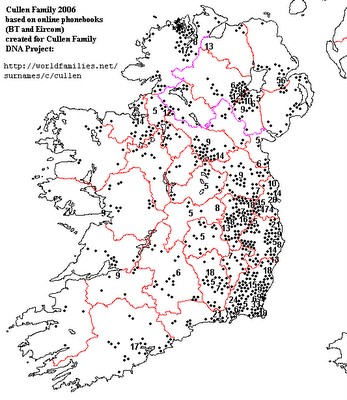
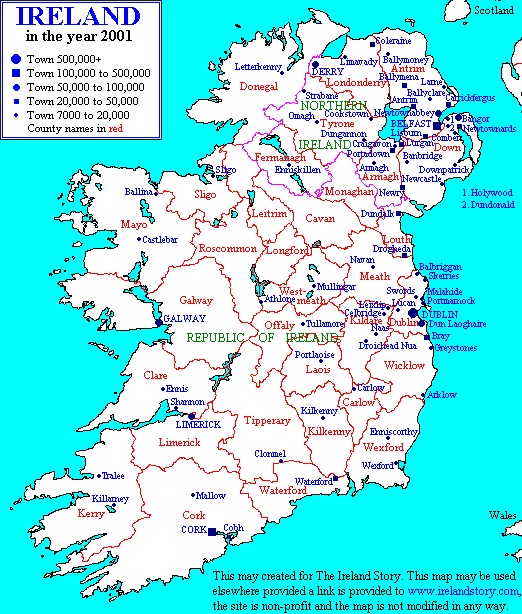
Download this map and you can see it in much better detail (doubleclick to see it fullscreen, or right-click and save the picture). This is based on Griffith's Valuation from the mid 1800s. I placed the dots on the map by hand, but they are mostly accurate. This map will be useful for the Cullen Family DNA Project: http://www.worldfamilies.net/surnames/c/cullen/ The red Xs are where some of our members' families are from, and the red ?s are our members who only know the county their Cullen ancestors are from. (If your eyes are good enough to see some bluish dots, those are families spelled Cullion or Cullian). Obviously, most of the Cullens lived in the southeast of Ireland, in Dublin, Wicklow, Wexford, and that's where we need to get more members. The second map shows the current distribution of Cullens based on online phone books. The lower map is a reference map showing county names and largest towns. It's from http://www.irelandstory.com/ which has lots of interesting maps and history.
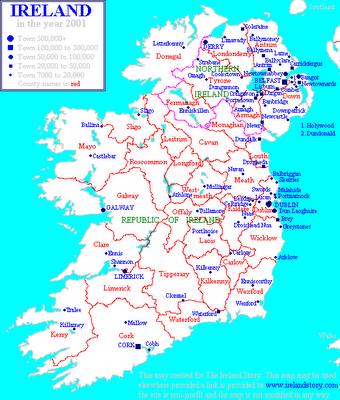

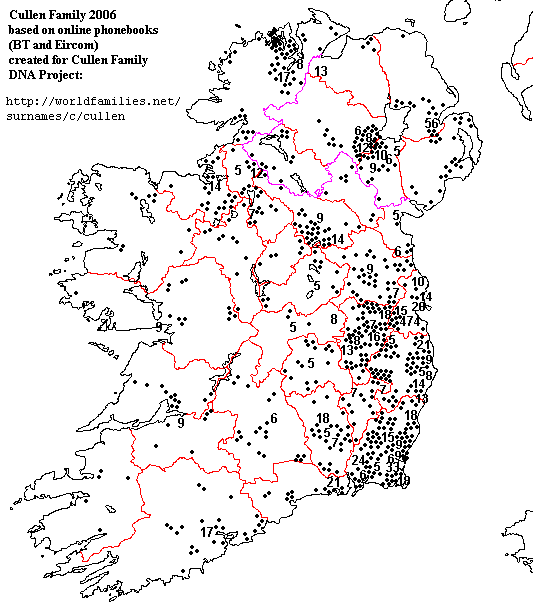
Download this map and you can see it in much better detail (doubleclick to see it fullscreen, or right-click and save the picture). This is based on Griffith's Valuation from the mid 1800s. I placed the dots on the map by hand, but they are mostly accurate. This map will be useful for the Cullen Family DNA Project: http://www.worldfamilies.net/surnames/c/cullen/ The red Xs are where some of our members' families are from, and the red ?s are our members who only know the county their Cullen ancestors are from. (If your eyes are good enough to see some bluish dots, those are families spelled Cullion or Cullian). Obviously, most of the Cullens lived in the southeast of Ireland, in Dublin, Wicklow, Wexford, and that's where we need to get more members. The second map shows the current distribution of Cullens based on online phone books. The lower map is a reference map showing county names and largest towns. It's from http://www.irelandstory.com/ which has lots of interesting maps and history.
Tuesday, August 01, 2006
Cullinane/Cullinane distribution map

Distribution of Cullinans and Cullinanes based on Griffith's Evaluation (1848-1868). Cullinan is the blue dots, and Cullinane is the red.
Compare this map to the map showing the distribution of Cullen, and note how there is little overlap. (except in Tyrone where my Cullens are from, and which is the only place in Ulster where Cullinan was found).
Monday, June 05, 2006
Cullens in Clogher history: Priests: Archdeacon Muireadhach O'Cuillen
from lewis' topographical dictionary of Ireland (1842):
Tyrone--Clogher
scroll down or search for Clogher or O'Cuillen:
Clogher is called by Ptolemy Rhigia or Regia; and according to some authors, St. Patrick founded and presided over a monastery here, which he resigned to St. Kertenn when he went to Armagh, to establish his famous abbey there; but according to others, it was built at the command of St. Patrick in the street before the royal palace of Ergal, by St. Macartin, whoe died in 506, and from its vicinity to this palace both the abbey and the town appear anciently to have been called Uriel or Ergal. In 841, the abbot Moran Mac Inrachty was slain by the Danes. In 1041 the church was rebuilt and dedicated to St. Macartin. In 1126 the Archdeacon Muireadhach O'Cuillen was killed by the people of Fermanagh. Moelisa O'Carrol, Bishop of Clogher, in 1183, on his translation of the archbishoprick of Armagh, presented to this abbey a priest's vestments and a mitre, and promised a pastoral staff; he also consecrated the abbey church. etc etc
Why did the people of Fermanagh kill the archdeacon?
Tyrone--Clogher
scroll down or search for Clogher or O'Cuillen:
Clogher is called by Ptolemy Rhigia or Regia; and according to some authors, St. Patrick founded and presided over a monastery here, which he resigned to St. Kertenn when he went to Armagh, to establish his famous abbey there; but according to others, it was built at the command of St. Patrick in the street before the royal palace of Ergal, by St. Macartin, whoe died in 506, and from its vicinity to this palace both the abbey and the town appear anciently to have been called Uriel or Ergal. In 841, the abbot Moran Mac Inrachty was slain by the Danes. In 1041 the church was rebuilt and dedicated to St. Macartin. In 1126 the Archdeacon Muireadhach O'Cuillen was killed by the people of Fermanagh. Moelisa O'Carrol, Bishop of Clogher, in 1183, on his translation of the archbishoprick of Armagh, presented to this abbey a priest's vestments and a mitre, and promised a pastoral staff; he also consecrated the abbey church. etc etc
Why did the people of Fermanagh kill the archdeacon?
Sunday, June 04, 2006
Cullens in Clogher history: Priests: Piers O'Cullen
from Military History magazine:
Irish Triumph at Yellow Ford
"Russell was only too glad when the Irish agreed to a truce in southeast Ulster, which lasted until the summer of 1597. During that time, however, the English were alarmed to learn that a priest named Piers O'Cullen of Clogher had sailed to Spain, bearing a letter dated September 19 and signed by O'Neill and O'Donnell. The letter beseeched the Spanish king to send 2,000 to 3,000 men, along with arms and money, to Ireland "to restore the faith of the [Catholic] Church and so secure you a kingdom." By seeking aid from England's principal rival, the Irish coalition was raising the stakes of the war"
Was O'Cullen from Clogher, or just priest there? Was he related to Bishop Cullen?
Irish Triumph at Yellow Ford
"Russell was only too glad when the Irish agreed to a truce in southeast Ulster, which lasted until the summer of 1597. During that time, however, the English were alarmed to learn that a priest named Piers O'Cullen of Clogher had sailed to Spain, bearing a letter dated September 19 and signed by O'Neill and O'Donnell. The letter beseeched the Spanish king to send 2,000 to 3,000 men, along with arms and money, to Ireland "to restore the faith of the [Catholic] Church and so secure you a kingdom." By seeking aid from England's principal rival, the Irish coalition was raising the stakes of the war"
Was O'Cullen from Clogher, or just priest there? Was he related to Bishop Cullen?
Saturday, June 03, 2006
Cullens in clogher history: Cullen's Point, Cormore
Clogher is a very small town in county tyrone which I visited in 1989. I also visited my Heagney relatives in Tullycorker, which is a townland (like a rural crossroads) just a couple miles to the north of Clogher. My Cullen ancestors are from Tullycorker, and there were Cullens living there in 1989, but we didn't know how our families were connected. I know they're not (male line) descendants of my ancestor Thomas Cullen who lived cir 1835-1900, but some could possibly be descendants of a brother of his, which would make them fourth cousins.
My major genealogy interest right now is sorting out all the Cullens in Clogher parish through microfilmed records. Most of the Cullens were in Tullycorker, but some lived in adjacent Cormore townland, and others in Eskernabrogue and Tycanny. Hopefully DNA testing (I need volunteers from Northern Ireland!!) will be able to determine whether these Cullens are all related, and whether they are related to any of the Cullinans who also lived in the area.
Thomas Cullen's wife was Mary McCann from adjacent Eskragh or Eskra townland. I did a google search for Clogher and Cullen and I found a wikipedia entry for Eskra. How does such a small place get mentioned on wikipedia?
wikipedia on Eskra
the main author of this aricle, who I believe goes by Ardfern, writes:
Many sites of penal day massrocks are still remembered by the local people. One such hallowed spot is 'The Altar Field' near Cullen's Point in the townland of Cormore. Another is in the hallow at the rear of the new church in Lisnarable. The old St. Patrick's Church - sometimes referred to as the 'Lower Mountain Church' was really a barn bought from a local farmer named Traynor and upgraded to serve as a church in the first quarter of the 19th century
Cullen's Point! I wonder if my father knows about it?
My major genealogy interest right now is sorting out all the Cullens in Clogher parish through microfilmed records. Most of the Cullens were in Tullycorker, but some lived in adjacent Cormore townland, and others in Eskernabrogue and Tycanny. Hopefully DNA testing (I need volunteers from Northern Ireland!!) will be able to determine whether these Cullens are all related, and whether they are related to any of the Cullinans who also lived in the area.
Thomas Cullen's wife was Mary McCann from adjacent Eskragh or Eskra townland. I did a google search for Clogher and Cullen and I found a wikipedia entry for Eskra. How does such a small place get mentioned on wikipedia?
wikipedia on Eskra
the main author of this aricle, who I believe goes by Ardfern, writes:
Many sites of penal day massrocks are still remembered by the local people. One such hallowed spot is 'The Altar Field' near Cullen's Point in the townland of Cormore. Another is in the hallow at the rear of the new church in Lisnarable. The old St. Patrick's Church - sometimes referred to as the 'Lower Mountain Church' was really a barn bought from a local farmer named Traynor and upgraded to serve as a church in the first quarter of the 19th century
Cullen's Point! I wonder if my father knows about it?
Monday, May 22, 2006
Famous Cullens
There aren't very many.
There is Countee Cullen, the Harlem Renaissance poet, but Cullen wasn't his birth name (see below).
There was Bill Cullen, the game show host. My great-aunts thought he might be a cousin but I don't think so. But maybe that means that their uncle Joseph had a son named William or Bill, we have lost track of his children.
There is Lord Cullen, who is/was the highest judge of Scotland.
There is Dr. Heidi Cullen on the Weather Channel.
There is Charles Cullen, the nurse/serial killer in New Jersey.
Here are some more suggested by readers of this blog:
Alice (McLaughlin) Cullen, of Glasgow, a leader of the local Labor Party and the first female Roman Catholic member of the British Parliament.
Bill Cullen, successful businessman (Renault Ireland), author and philanthropist.
Bernard Cullen, author and Professor of Philosophy at Queen's University, Belfast. His biography (scroll down)
Who else?
There is Countee Cullen, the Harlem Renaissance poet, but Cullen wasn't his birth name (see below).
There was Bill Cullen, the game show host. My great-aunts thought he might be a cousin but I don't think so. But maybe that means that their uncle Joseph had a son named William or Bill, we have lost track of his children.
There is Lord Cullen, who is/was the highest judge of Scotland.
There is Dr. Heidi Cullen on the Weather Channel.
There is Charles Cullen, the nurse/serial killer in New Jersey.
Here are some more suggested by readers of this blog:
Alice (McLaughlin) Cullen, of Glasgow, a leader of the local Labor Party and the first female Roman Catholic member of the British Parliament.
Bill Cullen, successful businessman (Renault Ireland), author and philanthropist.
Bernard Cullen, author and Professor of Philosophy at Queen's University, Belfast. His biography (scroll down)
Who else?
Thursday, May 11, 2006
Southern and Protestant Cullens
I think of Cullen as a typical Irish-American surname, with our ancestors emigrating during the potato famine in the 1840s and until the early 1900s, settling in the northeast/midwest, ending up in big cities even if that's not the first place they came to in America.
But I think there might be earlier Cullens in America, maybe from Ireland maybe from England, probably Protestant.
Probably one of the most famous people named Cullen wasn't really a Cullen:
from http://www.kirjasto.sci.fi/ccullen.htm
Countee Cullen was very secretive about his life. According to different sources, he was born in Louisville, Kentucy or Baltimore, Md. Cullen was possibly abandoned by his mother, and reared by a woman named Mrs. Porter, who was probably his paternal grandmother. Cullen once said that he was born in New York City - perhaps he did not mean it literally. Porter brought young Countee to Harlem when he was nine. She died in 1918. At the age of 15, Cullen was adopted unofficially by the Reverend F.A. Cullen, minister of Salem M.E. Church, one of the largest congregations of Harlem. Later Reverend Cullen became the head of the Harlem chapter of NAACP. His real mother did not contact him until he became famous in the 1920s.
But Rev. F.A. Cullen seems to be an illustrious African-American Cullen. Where was he from?
But I think there might be earlier Cullens in America, maybe from Ireland maybe from England, probably Protestant.
Probably one of the most famous people named Cullen wasn't really a Cullen:
from http://www.kirjasto.sci.fi/ccullen.htm
Countee Cullen was very secretive about his life. According to different sources, he was born in Louisville, Kentucy or Baltimore, Md. Cullen was possibly abandoned by his mother, and reared by a woman named Mrs. Porter, who was probably his paternal grandmother. Cullen once said that he was born in New York City - perhaps he did not mean it literally. Porter brought young Countee to Harlem when he was nine. She died in 1918. At the age of 15, Cullen was adopted unofficially by the Reverend F.A. Cullen, minister of Salem M.E. Church, one of the largest congregations of Harlem. Later Reverend Cullen became the head of the Harlem chapter of NAACP. His real mother did not contact him until he became famous in the 1920s.
But Rev. F.A. Cullen seems to be an illustrious African-American Cullen. Where was he from?
Saturday, May 06, 2006
Cullen as a German surname?
It could mean "From Cologne":
see
this link at about.com
Geographical Surnames - Derived from the location of the homestead from which the first bearer and his family lived (Leon Meer - Leon from by the sea). Other geographical surnames in Germany are derived from the state, region, or village of the first bearer's origin, often reflecting a division in tribes and regions, i.e. low German, middle German and upper German. (Paul Cullen - Paul from Koeln/Cologne). Surnames preceded by "on" are ovften clues to geographical surnames, not necessarily a sign that an ancestor was of nobility as many mistakenly believe. (Jacob von Bremen - Jacob from Bremen)
see
this link at about.com
Geographical Surnames - Derived from the location of the homestead from which the first bearer and his family lived (Leon Meer - Leon from by the sea). Other geographical surnames in Germany are derived from the state, region, or village of the first bearer's origin, often reflecting a division in tribes and regions, i.e. low German, middle German and upper German. (Paul Cullen - Paul from Koeln/Cologne). Surnames preceded by "on" are ovften clues to geographical surnames, not necessarily a sign that an ancestor was of nobility as many mistakenly believe. (Jacob von Bremen - Jacob from Bremen)
McGirr from Clogher, Tyrone
I've been corresponding with a woman named Ellen, who is researching her McGirr family (changed their name to McGarr) and McSorley from Clogher civil parish, County Tyrone, which is where my Cullen ancestors came from.
Here's some information on her McGirrs. Does anybody match this family?
Name became McGarr (I believe upon) arrival in US.
John McGirr & Susan McIlroy (or McIlray)
parents ofPatrick McGirr b 1840 Tyrone married Ellen McSorleyapprox 1866 in Ireland.
Children born in Dromore, Clogher Parish, Tyrone
Unnamed male 3 Nov 1867*
Mary - 25 March 1869
William - 2 November 1870**
Peter - 10 March 1872
Margaret - 3 September 1874
* might have died at childbirth and not named
** - my grandfather
I haven't been able to track down William's siblings in Ireland and don't know if they ever left Ireland.
Patrick and Ellen's marriage records could not be located. Suspect married in RC Aughintaine Church but apparently no records were kept until 1870.
Patrick, Ellen and William arrived New York City 6 June 1888 on the "State of Nevada".
William naturalized in 1984 married Delia Dougherty 28 August 1898 in Manhattan.
Children born in Brooklyn, New York
Mary b 1901 died 1958
Ellen b 1902 died 1904
John
Joseph b 1907 died 1952
Francis X. b 1914 died 1993.
Charles
William
Stephen
William died in the flu epidemic on Jan 26, 1917.
Delia died at age 67 in Brooklyn, NY. She was born in Donegal.Of William and Delia's children only Mary, John and Frank had children. I grew up on Long Island which is where some of your later McGirr's lived.
Here's some information on her McGirrs. Does anybody match this family?
Name became McGarr (I believe upon) arrival in US.
John McGirr & Susan McIlroy (or McIlray)
parents ofPatrick McGirr b 1840 Tyrone married Ellen McSorleyapprox 1866 in Ireland.
Children born in Dromore, Clogher Parish, Tyrone
Unnamed male 3 Nov 1867*
Mary - 25 March 1869
William - 2 November 1870**
Peter - 10 March 1872
Margaret - 3 September 1874
* might have died at childbirth and not named
** - my grandfather
I haven't been able to track down William's siblings in Ireland and don't know if they ever left Ireland.
Patrick and Ellen's marriage records could not be located. Suspect married in RC Aughintaine Church but apparently no records were kept until 1870.
Patrick, Ellen and William arrived New York City 6 June 1888 on the "State of Nevada".
William naturalized in 1984 married Delia Dougherty 28 August 1898 in Manhattan.
Children born in Brooklyn, New York
Mary b 1901 died 1958
Ellen b 1902 died 1904
John
Joseph b 1907 died 1952
Francis X. b 1914 died 1993.
Charles
William
Stephen
William died in the flu epidemic on Jan 26, 1917.
Delia died at age 67 in Brooklyn, NY. She was born in Donegal.Of William and Delia's children only Mary, John and Frank had children. I grew up on Long Island which is where some of your later McGirr's lived.
Wednesday, April 26, 2006
What does Cullen mean anyway?
Most people named Cullen are from Ireland, or have ancestors from Ireland, and I've read that the original name in Irish meant "holly tree", but others with the Irish name "whelp""small dog" have also been anglicized to Cullen.
And when I've been looking thru the records for my family from near Clogher, in County Tyrone, starting in 1860, my own ancestors seem to prefer to call themselves "Cullian", but they are also called Cullion, Cullen, Cullan, and even Cullinan.
Irish is hard@!
And when I've been looking thru the records for my family from near Clogher, in County Tyrone, starting in 1860, my own ancestors seem to prefer to call themselves "Cullian", but they are also called Cullion, Cullen, Cullan, and even Cullinan.
Irish is hard@!
Subscribe to:
Posts (Atom)